September 17, 2026
September 17, 2026
What Are Engineered Wood Products? Uses, Types, and Benefits
Roughly speaking, if you have walked through a warehouse, unloaded a shipping container, or built a set of shelves, you have almost certainly handled engineered wood without realizing it. This category of material has quietly become one of the most important building blocks in modern manufacturing and packaging. So what are engineered wood products, and why do so many industries rely on them? As a wood manufacturer in the Milwaukee region, we field this question often, and the short answer is that engineered wood combines the natural strength of timber with the consistency and predictability that industrial applications demand.
Unlike a single board cut straight from a log, engineered wood is created by binding wood fibers, veneers, strands, or lumber together using adhesives, heat, and pressure. The result is a material designed to perform in ways that solid wood alone cannot always match. Understanding how these products work helps you make smarter choices for construction, shipping, and long-term durability.
What Are Engineered Wood Products, Exactly?
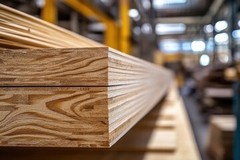
When people ask what are engineered wood products, they are usually surprised to learn how broad the category is. In simple terms, engineered wood is any product manufactured by bonding wood components together to form a stronger, more uniform material. This can involve thin sheets of veneer glued in layers, small wood strands compressed under pressure, or lengths of lumber joined to create longer, stronger beams.
The manufacturing process is what sets these products apart. By controlling moisture content, grain direction, and adhesive quality, manufacturers can produce material that resists warping, splitting, and shrinking far better than a single solid board. That consistency matters enormously in settings where every piece needs to perform the same way, from framing a building to protecting freight during a long overseas shipment.
The Main Types of Engineered Wood
Engineered wood is not one single material but a family of products, each suited to different jobs. Knowing the differences helps clarify why one type shows up in furniture while another supports a rooftop or a heavy industrial load.
- Plywood: Thin layers of wood veneer glued together with alternating grain directions, creating a strong, stable panel used in everything from cabinetry to crate construction.
- Oriented Strand Board (OSB): Compressed wood strands bonded with resin, commonly used for sheathing and packaging panels where cost and strength both matter.
- Laminated Veneer Lumber (LVL): Multiple veneer layers bonded to form long, strong beams that carry significant structural loads.
- Glulam (glued laminated timber): Layers of dimensional lumber bonded together to create large beams and arches for construction.
- Particleboard and MDF: Wood particles or fibers compressed with adhesive, often used in furniture and interior applications.
Each of these materials has strengths that make it the right fit for specific tasks. Plywood, for example, is prized for its resistance to cracking, which is exactly why it appears so often in protective packaging and shipping applications where impacts are common.
Where Engineered Wood Is Used
The uses for engineered wood stretch across nearly every industry. In residential and commercial construction, products like LVL and glulam form the backbone of floors, roofs, and load-bearing walls. Furniture makers depend on particleboard and MDF for smooth, stable surfaces. And in the world of manufacturing and logistics, engineered wood plays a starring role in packaging and material handling.
This is where our work becomes especially relevant. Shipping heavy or fragile goods requires materials that hold up under weight, movement, and changing conditions. Engineered wood panels are often combined with solid lumber to build sturdy crates and reinforced pallets. Businesses shipping through Milwaukee and beyond rely on these materials to keep products safe from the warehouse floor all the way to the final destination. If your operation depends on dependable freight protection, our custom wood crates and boxes are built with these principles in mind.
Engineered wood also shows up in industrial dunnage, bracing, and blocking, where consistency is critical. Because each piece behaves predictably, it is easier to design packaging that meets weight and safety requirements without guesswork. That reliability is one of the biggest reasons manufacturers continue asking what are engineered wood products and how they can be applied to their own shipping challenges.
The Benefits That Make Engineered Wood Worth Choosing
The advantages of engineered wood go well beyond convenience. One of the most significant benefits is strength-to-weight performance. Because the manufacturing process aligns and bonds wood fibers strategically, engineered products can carry heavy loads while often weighing less than comparable solid timber. That translates to lower shipping costs and easier handling.
Dimensional stability is another major benefit. Solid wood naturally expands, contracts, and can twist as humidity changes. Engineered wood is far more resistant to these movements, which keeps crates square, pallets flat, and structures true over time. For businesses that ship across regions with different climates, this stability helps prevent costly damage.
Sustainability is also part of the story. Many engineered wood products make efficient use of timber by turning smaller pieces, strands, and veneers into strong panels, reducing waste in the process. For companies focused on responsible sourcing, this efficient use of raw material is a meaningful advantage. When you understand what are engineered wood products capable of delivering in terms of strength, cost, and environmental efficiency, it becomes clear why they have earned such a permanent place in modern manufacturing.
Engineered Wood Versus Solid Wood in Packaging
A common question is whether engineered wood is better than solid lumber for packaging. The honest answer is that both have their place, and the best solutions often use them together. Solid lumber provides excellent structural framing and load-bearing support, which is why it remains the foundation of heavy-duty pallets and skids. Engineered panels, meanwhile, offer smooth, crack-resistant surfaces that shield goods from dust, debris, and impact.
When we design packaging, we consider the product being shipped, the transportation method, and the conditions it will face. A delicate electronic component and a rugged machine part call for very different builds. Combining engineered panels with quality lumber lets us tailor each solution precisely. You can explore how these materials come together across our full range of custom wooden packaging and pallets to see the flexibility this approach provides.
Building the Right Solution for Your Business
Engineered wood has transformed the way industries build, ship, and protect their products, offering a rare combination of strength, consistency, and efficiency. From plywood panels and LVL beams to the reinforced crates that safeguard freight, these materials solve problems that solid wood alone cannot always address. Once you understand the types, uses, and benefits, choosing the right material for a given job becomes far less mysterious.
At Ongna Wood Products, we bring that knowledge to every project we take on for customers in Milwaukee, Baraboo, and the surrounding communities. Whether you need dependable shipping solutions like custom wood pallets in Portage or protective packaging such as custom wood crates in Oak Creek, we combine engineered materials and solid lumber to fit your exact requirements.
If you are weighing your options and want guidance on the best material for your goods, our team is glad to help you find the right approach. Reach out through our contact page to discuss your project, and let us build packaging that protects what matters most to your business.
Recent Posts
-
-
September 15, 2026
Before You Ship: Are Wood Pallets Treated?
-
September 3, 2026
Basic Wood Products for Shipping That Help Protect Freight
-
September 1, 2026
Skid Material Basics: What Wood Are Skids Made Of?